by Stefan Heinze | Feb, 2026 | famous people from Bonn, Music, Uncategorized
Beethoven was born in Bonn in 1770 and lived and composed there until 1792. Beethoven’s first printed composition appeared as early as 1782. That is why Bonn is also known as Beethoven City. This blog aims to show that Beethoven can be experienced in Bonn with different senses.
Seeing
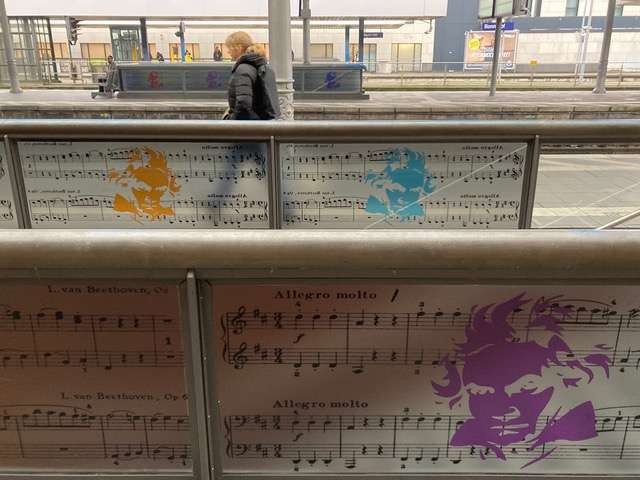
If you arrive by train, the first references to Beethoven can be found on the banisters and doors of the main station building, as well as at the station mission.
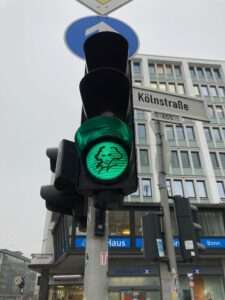
Some traffic lights also show that Beethoven was born in this city when they turn green.
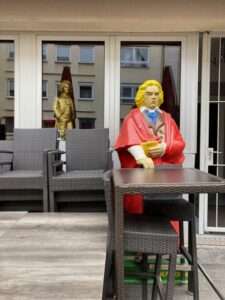
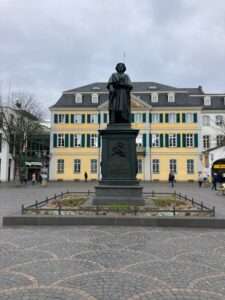
If you walk through the city with your eyes open, you will not only find the large Beethoven statue on Münsterplatz, but also many Beethoven figures by Ottmar Hörl (in gold, green, purple, or blue), which were created to mark the 250th anniversary of Beethoven’s birth and show the young, smiling Beethoven. (Beethoven Model 2019| Work | Ottmar Hörl). Beethoven looks down on passers-by not only from shop windows, but also from balconies and canopies.
Sometimes you can even find homemade Beethoven figures: one example sits in the shop window of the Maas fashion store opposite the Beethoven House.
 Further Beethoven artworks can be found in the Rheinaue or in the Stadtgarten. Here, Markus Lüpertz has depicted Beethoven as a sick man.
Not every work of art is recognizable as a Beethoven monument at 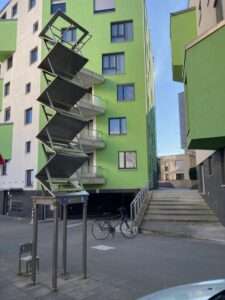 first glance: sculptor Yukako Ando has erected a desk in Rheingasse (the place where Beethoven was rescued from the second floor during the highest flood ever recorded in 1784) whose work surface rises like an accordion and merges into an open window. From this window, Beethoven had a view of the Rhine, the Beuel side, and the Siebengebirge mountains. A bird sits as a symbol of freedom.
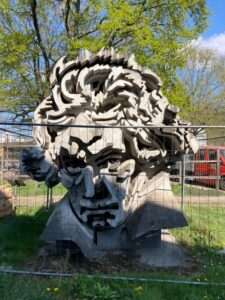 In front of the Beethovenhalle stands Beethoven by Klaus Kammerichs – an extraordinary bust made of concrete.
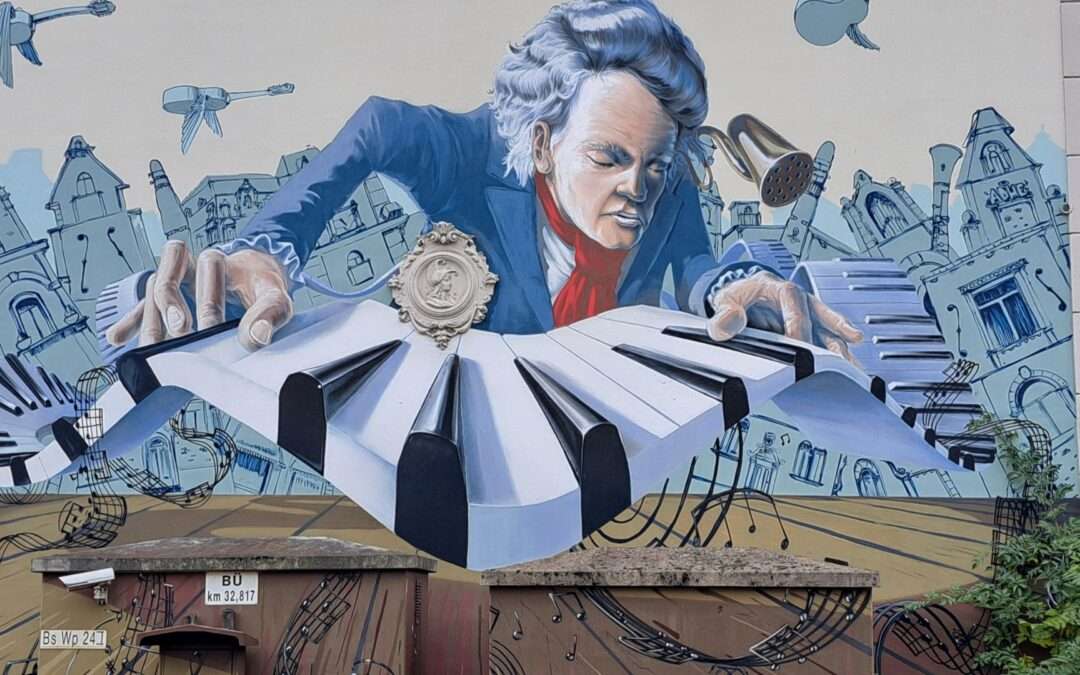
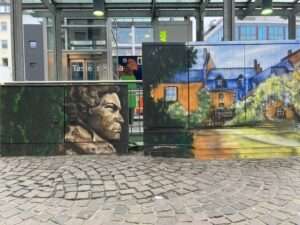
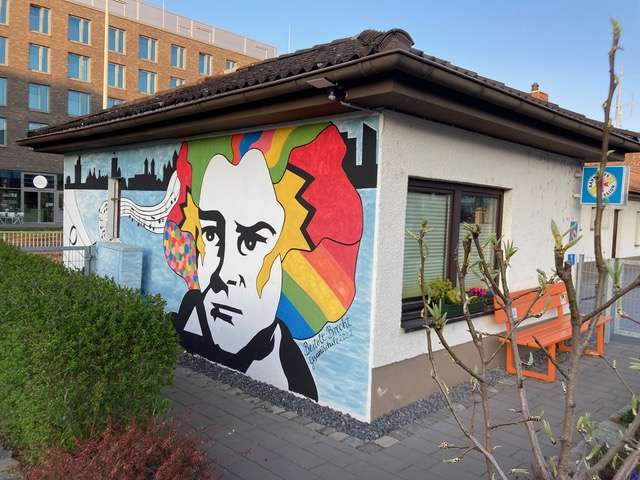
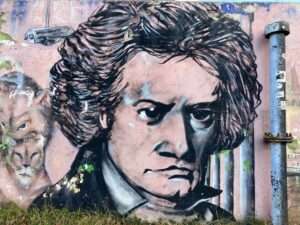
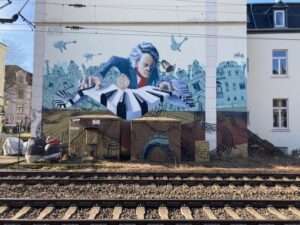
The great composer can also be seen on walls and electrical boxes: the wall of the railway station mission is decorated with Beethoven. Another mural can be viewed above the railway tracks at the corner of Kaiserstraße and Weberstraße. There are even two large murals in the Beuel district (Anniversary year: Street art in Bonn honors Beethoven – meikemeilen -).
by Gert Fischer | Dec, 2024 | Bonn Sights, EN, points of interest, tradition, Uncategorized
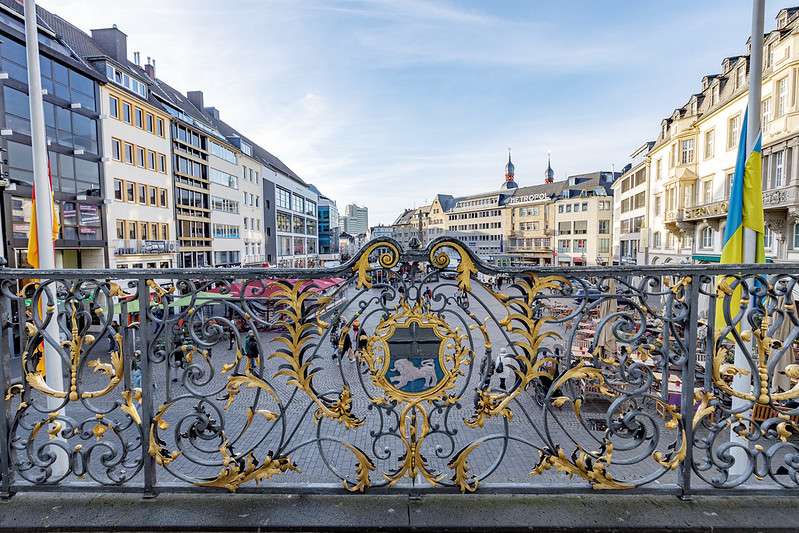
The flight of steps at the Old City Hall has seen better days. Its grand appearances have become rare. Nowadays it only takes centre stage on Carnival Sunday, when the carnival revellers storm the town hall. In addition, there are rare events in which it briefly regains its former grandeur as a big stage. This occurred in 2023, when the Telekom Baskets (Bonn’s professional basketball team) were celebrated by their fans after winning the Champions League. Although there was a good turn-out by the fans, they still did not fill the market square, not unlike the party-goers on Carnival Sunday. It was a completely different scenario when Charles de Gaulle signed the city’s Golden Book on the September 5, 1962. He stepped out onto the staircase together with Konrad Adenauer to a storm of enthusiasm. The market square and the Bischofsplatz were packed with people, who were overflowing into the Sternstraße and the Wenzelgasse. After delivering a seemingly extemporaneous speech in German, the then assassination-threatened French President strode down the stairs and was swallowed up by the crowd, much to the dismay of his security staff.
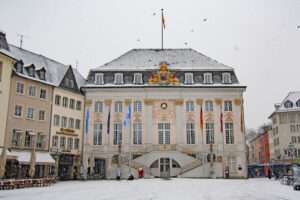
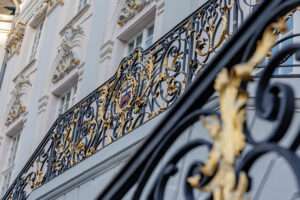
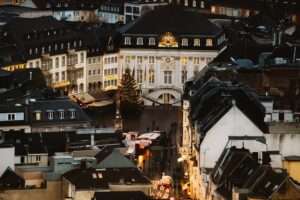
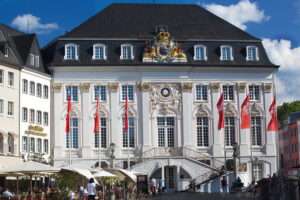 The steps of Bonn’s old City Hall have seen similar scenes time and again, especially when Bonn was the capital city of Germany. The list of visitors ranged from Theodor Heuss, who addressed the German people from the steps immediately after his election as the first Federal President, to John F. Kennedy in 1963, the Queen Elizabeth of England in 1965, and as late as 1989 when Gorbachev visited. Not all occasions were as spectacular as in the 60s, and over time, state visits became routine. Nevertheless, the steps of the town hall remained something of a stage for the Bonn Republic. The reason for this was mundane: the government district was somewhat remote and, as a provisional arrangement, had no representative assembly area. The market square helped out.
Incidentally, the same applies to demonstrations. Up until the 1980s the Bonn market was the most important demonstration site in the Federal Republic of Germany. The steps of the town hall also played a role there – perhaps most ingloriously on 10 April 1973, when members of a communist splinter group, hidden by a student demonstration against the visit of the South Vietnamese president to Germany, stormed the town hall and smashed its interior. It was only then that, because of the sheer volume, the protests against rearmament had to move to the Hofgarten. They may not have been aware of the meaning of their actions in terms of the carnival. At that time, we lived nearby, and I still remember how the demonstrators, linked arms and running, turned from Suttnerplatz into Rathausgasse, chanting the name of Ho Chi Minh. The rest is history.
The staircase was also the scene of much earlier revolutionary events: on 20 March 1848, for example, Gottfried Kinkel led a procession of citizens, professors and students. Armed with the black, red and gold flag of the democratic movement, he climbed the steps of the town hall and spoke, as Carl Schurz put it, with ‘wondrous eloquence’. Things were less lively on October 24, 1923 when local separatists, under the protection of French soldiers, climbed the steps at 6 am and claimed the ‘Rhenish Republic’. The nightmare was soon over due to a lack of support from the population.
The importance the Bonn market once played, both in front of the town hall and with the town hall steps as a natural stage, has now almost been forgotten. Recently a major radio station, the SWR, stated that de Gaulle gave his speech in the Hofgarten. And Bonn only occasionally remembers the possibilities that the town hall panorama offers. A big festival where the stage covers the old town hall is a wasted opportunity. Nowadays, the people who make the most of the opportunities are the bridal couples who get married at this historic site. They are happy to use the flight of steps for their guests to form a guard of honour, thus preserving some of the charm of the place. It’s just a shame that the delivery truck traffic is increasingly disrupting the beautiful images. This impression may be subjective.



Recent Comments